

















It’s going to be fun, it’s going to be interesting, and it’s going to be exciting.
Dr. Craig Holmes
Economist & Senior Academic Fellow at the University of Oxford

Industry-Backed Case Study
Designed with professionals from Goldman Sachs, Citibank, and the University of Oxford.

Financial Trading Simulation
Round 1 of the Economics World Cup is a financial trading simulation designed by professional commodity traders.


No Prior Knowledge Required
Economics is simply how people make choices with the resources they have. You already use it every single day.

Internet Allowed
Because real economists use all tools available to them.

Minimum Time Commitment
Last year, the average participant spent 5.9 hours throughout the competition.

100% Virtual Experience
You can join from the comfort of home.

Grand Prize
Get a bespoke trip to the University of Oxford, where you will get to engage with Oxford professors and students.
You are allowed to bring 1 teacher with you on this free trip.
Accommodation Included
Transport Included

Second Prize
You will join Derya AI and contribute to a live investor relations project alongside their team.
You will gain hands-on startup experience and help guide a project with real business impact.
Mentorship from founders
Y-Combinator Startup

The entire team and 1 teacher will get an iPad.
The iPad features the A16 chip, 128GB of storage, a Liquid Retina display and up to 10 hours of battery life.
A16 chip
Liquid Retina display
Wild Card Prizes
Additional prizes will also be awarded for:
Best Speaker
Most Creative Solution
Most Sustainable Solution
Emerging Young Talents
And more…
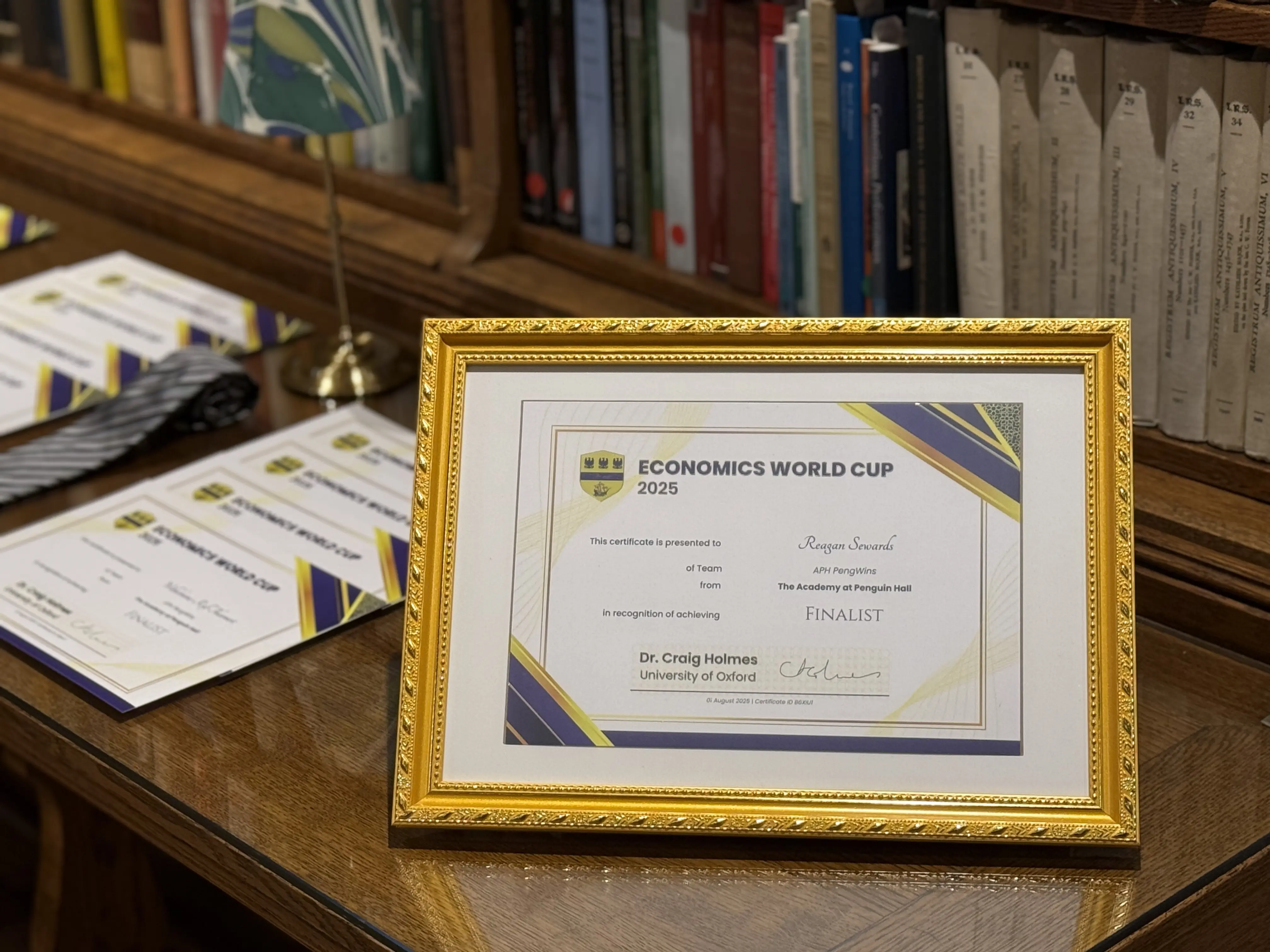
Certificate of Recognition






How It Works
In Treasure Wars™, your team competes live against EWC participants from around the world to bid for mystery chests.
Some chests will contain a lot of gold. Some will contain nothing. Some will be traps.
To win, your team must think like gold options traders: weighing risk against reward, reading your rivals, and knowing when to go all in.
School Teams Qualify Together
If any one team from your school finishes in the top 20%, all teams from your school progress to the Finals.

Your team receives an industry-backed case study to solve.
The case study has been developed at the University of Oxford in collaboration with Oxford Finance Society and industry professionals at investment banks such as Goldman Sachs and Citibank.
See past case studies here.

Your team creates a proposal for a real client.
You can share your solution as either:
Video (max 5 minutes)
Report (max 2 pages / 1000 words)
Presentation (max 10 slides)
Podcast (max 10 minutes)

The jury reviews your submission.
Will your team impress the Economics World Cup Advisory Board?

Meet Team Cooply and Demand, the winners of the 2025 Economics World Cup.
Mentorship from Oxford Finance Society
OFS will provide two training workshops to all EWC participants.
How McKinsey consultants use the SCR framework to make any argument more persuasive
Deep dive into the Goldman Sachs problem-solving and analysis toolkit

Virtual Roundtable with Professor Craig Holmes
After the finals, you will be invited to a virtual roundtable with Dr. Craig Holmes, a leading University of Oxford economist.
Dr. Holmes will share what it’s like to work in economics and offer an insider’s perspective on applying to top universities.

All Tools Allowed
Economists do not rely on facts they have memorized. They consult research, leverage technology, and draw on every available resource to arrive at the best decision.
In this spirit, you are encouraged to use academic research, AI, and other external resources.

Appropriate Across Age Groups 13 - 19
For older students
A strong supplement to the humanities curriculum and a highly relevant experience to discuss in university applications.
For younger students
An early introduction to economics in a fun, competitive setting that helps you explore whether it’s a subject or career path you would like to pursue.
Fair and accessible across all ages
Younger students get graded with a coefficient, and there are awards specifically reserved for younger participants.


Pictured: Students from Ningbo International School pose for a photograph after an award ceremony.
Boost Your University and Internship Applications
Provides credible evidence of interest
Many students aiming for economics, politics, business, or finance have not studied these subjects formally in school, making participation a credible differentiator.
Remains relevant long after the competition ends
Every year, students tell us they reference their EWC experience in their internship applications and interviews as evidence of developed skills.
Get mentored by elite students
You will have the opportunity to get mentored by students who got accepted into the world's most elite universities like Oxford, Yale, and Cornell. Many of these students now intern at global firms like Goldman Sachs, McKinsey, Amazon, and Microsoft.
Zero barriers to entry
Shows where classroom learning leads
Most schools already do an excellent job teaching theory, so there is little value in retesting this knowledge. Instead, the EWC provides a platform for you to see economics in practice, answering the age-old question: “When will we ever use this in the real world?”
No prior knowledge required
The EWC is intentionally designed to be accessible even in schools where economics is not part of the curriculum. You will not need to know any theories to be able to see them in action.
Fits easily into busy schedules
No preparation is required. Round 1 takes about 20 minutes per day. Round 2 takes 3–7 hours over a span of one week.


An applied approach to learning economics
Early professional exposure
You will learn from professionals at the Oxford Finance Society, develop skills such as leadership and time management, and begin building your first professional network.
Aligned with global priorities
Each year’s EWC experience is built around selected UN Sustainable Development Goals, woven naturally into the case to build meaningful awareness.
Global student collaboration
All finalists will be invited to an online (moderated) community, where you will be able to discuss the development case together and connect across cultures.

“The EWC case studies have reached a level where there is simply no comparable academic enrichment opportunity for high school humanities students.”
Fatih Deveci
High School Principal, International School of Hellerup

Craig Holmes
Dr Craig Holmes is a Professor of Economics and the Helena and Simon Crow Lecturer at Pembroke College, University of Oxford, where he also conducts research.

Luigi Gagliardi
Dr. Luigi Gagliardi is the CIO of VELUX, a Danish multinational corporation with annual revenues of $4B. Previously, he was Head of Manufacturing at Novo Nordisk.

Caroline Anne
Caroline Anne is an Equity Analyst at Goldman Sachs, with prior experience at the hedge fund Schonfeld. Her research has been featured in the Financial Times.
1.

Talk to your friends and fellow students to organize a team of 2-6 students.
If you cannot find any teammates, no worries. You can register individually and we will match you with a top-notch team after the registration period ends.
2.

Sign up for the Economics World Cup individually using your personal email.
3.

After you sign up, we will send you a form where you can register your teammates and team name.









Is there a reading list that I should use to prepare?
No, there is no reading list to prepare for.
How many students can be in a team?
A team can have 1-6 students.
How do I sign up with my team?
Everyone in your team must register individually. Once the sign-ups close, we will send out a “Team Sign-Up” form and you will be able to record your team on the official directory. Make sure you are checking your emails frequently, including spam.
What if my teammate has not signed up individually?
Every member of the team is required to complete their individual registration and payment before submitting the team sign-ups. Should your team advance to the final round, but any of your teammates have not registered individually, your entire team risks being disqualified.
Who is eligible to participate?
Anyone who has yet to start a bachelor's degree by 1 August 2027 is allowed to participate. Students on a gap year are allowed to participate.
Can I invite my friends from other schools to be a part of my team?
There are no restrictions on team formation. You are free to team up with anyone you would like, regardless of school, country, or any other factor.